- 9,1/104,5 out of 5 stars. See our reviews on Kiyoh (opens in a new window)
- Ordered in no time
- Fast delivery
- Sorted quickly
Clean soil declaration: how does it work?
23 april 2019 · Ruud Bats
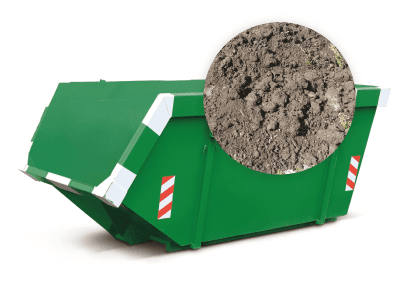
When building or renovating a house, or landscaping or digging out your garden, you often end up with a lot of soil left over. Clean soil is removed separately in a soil skip and must not be mixed with other construction and demolition waste. But note: the soil can only be removed once it has been declared clean. You can apply for a clean soil declaration for this, but how exactly does it work?
Postcode check
For small amounts of soil (such as with a 3m3 or 6m3 container), a postcode check is enough. When you order a soil skip, we check in advance that the soil doesn't come from an area known to be heavily contaminated. You don't have to worry about this yourself. If you're having more than a few cubic metres of soil removed, or you're planning to build a house, a postcode check isn't enough and you'll definitely need a clean soil declaration.
What is a clean soil declaration?
A clean soil declaration is a statement that the soil is clean, meaning there is no serious soil contamination. Contaminated soil contains large amounts of hazardous substances. These are often substances such as heavy metals, oil, asbestos, pesticides, polycyclic aromatic hydrocarbons (PAHs), dioxins or chemicals such as cyanides. However, the soil doesn't have to be spotless. If the soil is only slightly contaminated, it poses no risk to public health and a clean soil declaration is usually issued. You need a clean soil declaration when you're going to build or renovate and need to apply for planning permission.
Why do I need a clean soil declaration?
Soil contamination is fairly common in the Netherlands. At around 250,000 locations in the country, the soil is seriously polluted. Much of this contamination arose in places where pesticides were used in the past, or where petrol stations, garages or gasworks once stood. For houses built after 1992, the risk of soil contamination is much lower. That's because soil legislation came into force around that time, with various rules to prevent further soil pollution in the Netherlands. But soil contamination can still occur today. It's often caused by rules not being followed, illegal fly-tipping or industrial accidents. It's important to know whether the land being built on or renovated is contaminated, because seriously polluted soil is harmful to people and the environment. Soil removed in soil skips doesn't go through a long recycling process, but is reused straight away. So there can be no risk of contaminated soil ending up in it.
How do I get a clean soil declaration?
If you're going to build a house or an extension, you'll need planning permission. To get this, a clean soil declaration is required. There are several ways to obtain one:
1. When buying a property
When you buy a house or a plot of land, you have a 'duty to investigate'. This means you're obliged to find out for yourself whether the soil is contaminated. The seller only has a 'duty to disclose'. This means they're required to inform the buyer about any soil contamination they know of, but they don't have to investigate it themselves. Sometimes a soil survey has already been carried out and you can use the existing clean soil declaration, provided it's still valid. There's no legal expiry period for a soil survey, but many municipalities and the government use 5 years.
2. Applying to the municipality
For houses built after 1992, there's a good chance the municipality holds a clean soil declaration. You can request it from the relevant municipality. If it's available, the municipality is obliged to let you see it. In addition, municipalities and large provinces carry out a soil remediation policy every year, in which they map contaminated locations.
3. Having a soil survey carried out
If no clean soil declaration is available, you'll need to have a survey carried out yourself. As the owner, you're responsible for this survey and its costs. The survey involves drilling one or more boreholes. The number of boreholes depends on the size of the area to be surveyed. The soil samples and collected groundwater are then analysed. Based on the results, it's determined whether there is soil contamination and whether further investigation is needed. The cost of the survey depends on various factors.
Historical survey
In some cases, a historical survey may be sufficient. This can be carried out by the municipality, the environmental department or the regional environmental service. It looks into possible sources of contamination in the past. Among other things, the survey gathers information about the past and current use of the site. It also looks at the geohydrology and sometimes the legal aspects. In addition, an on-site inspection is carried out and sometimes an aerial photo is taken. Interviews with owners and local residents may also take place. Based on the results, a decision is made on whether further soil investigation is needed.
Online check
There are also various websites that can help you obtain the declaration. On Omgevingsdienst NL you'll find a map of all the regional environmental services in the Netherlands, which can help you further with obtaining the declaration. Via Bodemloket you'll find all the soil contamination data known to the government. The map shows where companies used to be located or where work was carried out that may have affected the soil quality.
Take a look at our frequently asked questions or chat with, e-mail or call one of our team members. @ info@containeronline.nl tel.: 085-3035343
More posts
9 August 2021 · Garden
How to place a skip on your own property without damage
A skip on your own property? It's handy, but it can cause damage. Find out the best way to prevent it.
Continue reading