- 9,1/104,5 out of 5 stars. See our reviews on Kiyoh (opens in a new window)
- Ordered in no time
- Fast delivery
- Sorted quickly
Skip hire for mixed waste: what can go in?
2 maart 2020 · Ruud Bats
When you're doing DIY, renovating or moving house, it's handy to get a hire a skip. If you have lots of different waste types, you'll often be advised to choose a 'mixed waste skip'. Good advice, but 'mixed waste' is quite a broad term. What does it actually mean, and what can you put in a skip like that?
Mixed waste = construction and demolition waste
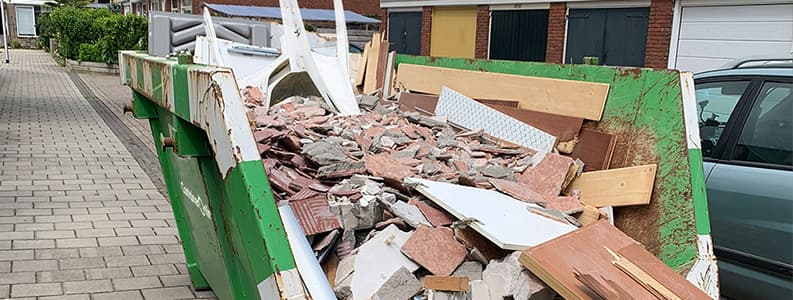
By mixed waste, we mean construction and demolition waste. A mixed waste skip is a builder's skip for different waste types, including, for example, wood, plaster, rubble and metal. It's called a mixed waste skip because you can get rid of much of the waste produced during a renovation. For many of these waste types, you can also order a separate skip. Even so, a mixed skip is the most practical solution for many jobs, because you spend very little time disposing of your waste. On top of that, a renovation often produces small amounts of several different waste streams. If you had to put each of these in a separate skip, you'd need lots of skips, none of which would get full. And that would be a waste.
Saving on your waste skip
If you mainly have 1 waste type and only a little other waste, it may be a waste of money to hire a construction and demolition waste skip, as these are more expensive. For example, if you're knocking down a wall and mostly have bricks and stone with a few pipes or a bit of wood, it's cheaper to hire a rubble skip and take the small amount of other waste to the recycling centre, or to use a Big Bag for it.
What counts as mixed waste?
As described above, mixed waste consists of different waste streams produced during renovations. The waste types allowed in the skip are:
- Rubble and stones
- Aerated concrete
- (Reinforced) concrete
- Plaster
- Ceiling tiles
- Wood, parquet and laminate
- Insulation material
- Metals
- Radiators
- Paper and cardboard
- Plastics
- Plastics (for example window frames)
- Household items and bulky waste
Although lots of different waste can be collected together, not all waste types are allowed. The following waste types don't belong in a mixed skip, also known as a construction and demolition skip:
- Asbestos or asbestos-like material
- Corrugated roofing sheets
- Car tyres
- Roofing waste– roofing felt, bitumen, roofing gravel with material stuck to it
- Hazardous waste, small chemical waste
- Electrical appliances
- Batteries (corrosive or irritant substances)
- Organic waste
- Residual waste/household waste
- Hazardous waste, chemical waste
- Soil/sweepings
This waste isn't allowed in a mixed skip because, for example, it's hazardous (asbestos-containing or asbestos-like material, batteries, chemical waste), it can contaminate the other waste types (roofing waste, roofing felt) or it can no longer be sorted (soil).
Not sure which waste can go in a mixed skip? We're happy to help. And if you have waste that isn't allowed in a mixed skip (or any other skip), we'll gladly help you find a sustainable and safe way to get rid of it. If you're clearing out your home or need to clear a house after a death, it's best to get a hire a household goods skip.
Can mixed waste be recycled?
Waste is best recycled when it's collected separately. Even so, the waste in a mixed waste skip can also be recycled, but the process is a bit more involved. The recycling process starts by separating the waste afterwards. First, the large pieces of waste and furniture are removed (often by hand). The smaller pieces are placed on a sorting belt and separated by machine. Metals are removed with magnets, and paper waste, plastic waste and wood are also separated from one another. This is done using water or infrared. Finally, the waste is checked carefully once more and, where necessary, sorted again by hand.
More posts

10 March 2026 · Waste types
Why hiring a waste skip is good for the environment
Skip hire. Waste has a bad reputation, but when you handle it responsibly, it's actually good for society. So go ahead and renovate!
Continue reading