- 9,1/104,5 out of 5 stars. See our reviews on Kiyoh (opens in a new window)
- Ordered in no time
- Fast delivery
- Sorted quickly
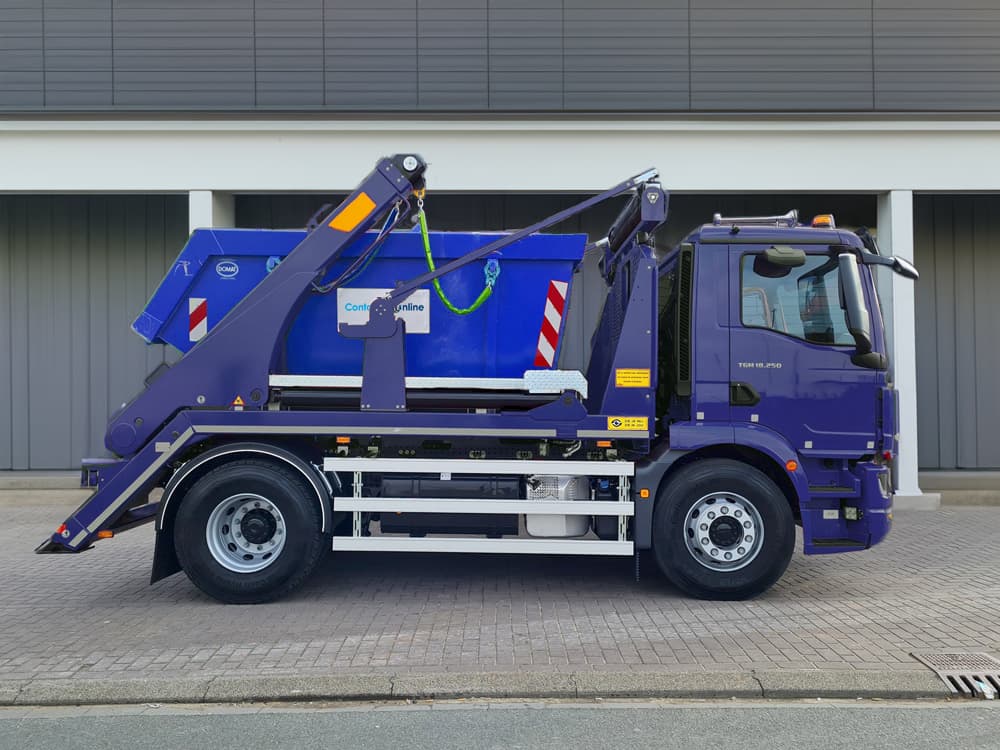
What is a chain-lift skip?
13 juli 2023 · Ruud Bats
You may have heard the term chain-lift skip before, but what is it exactly? Is it just for the building trade, or can you hire one as a private customer too? Chain-lift skips are used a lot in construction, but plenty of private customers use them too. They're a great help when you have a lot of waste.
On the building site
Picture yourself walking past a building site. There are building materials everywhere, machines dotted around, and dust and noise all over the place. In the middle of all this sits a giant metal box, still and steady, holding everything you throw in until it's collected. That metal box is a chain-lift skip, a trusty companion on many building projects.
What is a chain-lift skip?
At its simplest, a chain-lift skip is a large metal container that's open at the top. On large projects such as building or renovation work, managing waste efficiently is essential. That's where the chain-lift skip comes in.
Chain-lift skips are used to collect waste and building rubble. Made from sturdy steel, they're designed to hold all kinds of materials, from household waste and garden waste to construction and demolition waste. But what sets a chain-lift skip apart from other types of container?
Chain-lift skip vs hook-lift container
As well as the chain-lift skip, there's the hook-lift container. Both are essential tools in waste management, but their design and operation are quite different. The main difference is how they're transported and put in place.
Chain-lift skip
A chain-lift skip is transported on a purpose-built lorry, known as a skip lorry. This lorry has a hydraulic lifting arm that lifts the skip using chains. This design makes it easy to lift the skip off the ground and load it onto the lorry, and to unload it efficiently at its destination.
The big advantage of chain-lift skips is that they're relatively light, so the lorry that collects them needs less power. The lorry can therefore be smaller and uses less fuel. Empty chain-lift skips can also be stacked inside each other, so several can be carried per trip. That's why chain-lift skips are relatively cheaper than hook-lift containers. Sometimes, for example, two 10m3 chain-lift skips can be cheaper than one 20 cubic metre hook-lift container.
Chain-lift skips come in 3m3, 6m3 and 10m3. The 10 m 3 skip is also often called a 9m3 skip. This is just a naming choice: they're the same skips, and the capacity sits somewhere in between.
Hook-lift container
A hook-lift container, on the other hand, is transported using a hook-lift system. Instead of chains, this system uses a large metal hook that attaches to the back of the container to lift it and pull it onto the lorry. This is also an efficient way to load and unload containers, but it needs more space than the chain-lift system and the lorry needs more power.
A big advantage of hook-lift containers is that they usually have a door you can open, so you can wheel a wheelbarrow straight in, for example.
Hook-lift containers come as a 15m3 rubble skip, 20m3 and 40m3. They're often used on large building projects or when clearing a house after a death.
Delivering and collecting a chain-lift skip
Delivering and collecting a chain-lift skip is as simple as it sounds. First, the spot where the skip will stand is chosen. The ground needs to be firm and level so the skip doesn't tip over or sink. The lorry reverses up to the spot and lowers the skip from the back of the lorry into place.
For collection, the same process happens in reverse.
Advantages of chain-lift skips
Chain-lift skips have several advantages that make them a popular choice for waste management.
- Flexibility: Thanks to their design, chain-lift skips are easy to place in spots where other types of container might not fit or would be hard to put.
- Sustainability: Chain-lift skips are made of heavy steel, so they're very durable. They can carry heavy loads and stand up to rough use.
- Efficiency: Because a purpose-built lorry is used, the skip can be delivered and collected quickly and easily.
- Versatility: Skips come in a range of sizes and can be used for many types of waste, from construction waste to garden waste.
Essential for building work
A skip is a heavyweight champion in the world of waste management. It makes it easy to get rid of your waste and keeps your work area clean and tidy. So it's no surprise that the skip is an essential tool for renovations, on building sites and anywhere else where waste management really matters. On building projects you'll usually spot a rubble skip or a container for construction waste.
More posts
1 May 2026 · Containers
Rubble skip vs construction waste skip: what's the difference?
When renovating or demolishing, the question soon arises: should you choose a rubble skip or a construction waste skip?
Continue reading
9 June 2025 · Containers
When is hiring a 20m³ skip worth it?
Planning a big renovation or clear-out? Find out when a 20m³ skip is worth it and what you can dispose of in it. Including costs and tips.
Continue reading