- 9,1/104,5 out of 5 stars. See our reviews on Kiyoh (opens in a new window)
- Ordered in no time
- Fast delivery
- Sorted quickly

6 tips to avoid extra costs
11 mei 2026 · Ruud Bats
When you hire a skip for a job, you pay for the skip hire, delivery, collection and processing of the waste. This is a fixed price, but it can sometimes go up, for example if you receive a surcharge afterwards. That's a shame, because it makes your job unexpectedly more expensive. That's why we've put together 6 tips to help you avoid extra costs.
Tip 1 – Your own property: enough space and good advice
Placing a skip on your own property is often very convenient, but it can also lead to extra costs. A waste skip is very heavy. You'll want to avoid damaging the paving and, of course, you don't want any damage to your own property. Placing a skip on your own property always carries a risk. The local council sets requirements for access and paving. If you want the skip on your own land, the lorry may not be able to get where you want it, the skip may not fit there, or the ground may not be able to bear the weight. This can't always be determined in advance. It's quite possible that the skip can be put down, but can no longer be collected once it's full. For example, if the skip is very heavy and the lorry needs to use outriggers (a kind of stabiliser leg), but there's no room for them. Or if a pallet of bricks has been placed in the way, so the skip can no longer be lifted. Extra costs may then be charged. So always make sure the lorry has enough space and can reach the skip easily. If you're unsure, ask the driver for advice and explain clearly what you're planning.
Tip 2 – Avoid wasted trips
If the driver can't deliver or collect the skip, you'll be charged for a wasted trip. That's a shame, especially because a wasted trip is easy to avoid. The same applies to a skip that's too heavy. This won't happen very often, though, because the skip is matched to the waste type. Still unsure? Get in touch and we'll help you work it out.
Parking space
If the skip is going in a parking space, make sure it's still free when the lorry arrives. Park your own car there, or mark it off with tape or something similar. Also think about how the skip is put down. It sits on a skip loader lorry and is lowered behind it on chains. If the skip needs to go in a parking space parallel to the road, you'll actually need 2 spaces in a row: 1 for the skip loader lorry and 1 for the skip that's placed behind it.
No space
Even if the skip is going somewhere other than a parking space, there must be enough room for the skip itself and for placing it. If the skip is very heavily loaded, outriggers will be needed next to the lorry when it's collected, and there has to be room for these. A bollard in the wrong place can be enough to stop the skip being lifted. So always make sure there's enough space around the skip, and talk to the driver if you're unsure.
Not accessible
If the lorry can't get close to the agreed spot to deliver or collect the skip, this also counts as a wasted trip. So make sure the route is clear for a large lorry. Also check whether there are any streets along the way with weight or size restrictions, or a small bridge the lorry might not be able to cross. Let your neighbours know a skip is being delivered and ask them to bear it in mind when parking their cars. That way, the lorry won't be blocked from getting past or making a necessary turn.
Too heavy or loaded incorrectly
If the skip is too heavy, or the weight is badly distributed, the skip loader lorry can't lift it. So pay close attention to how you fill the skip and spread the weight as evenly as possible. A rubble skip is designed for rubble to be thrown in loosely. If, for example, you have lots of paving bricks and stack them all neatly side by side, it may end up too heavy. The same goes for a skip full of sand or soil that you've compacted.
Too high
A skip may be loaded up to 20 centimetres above the rim. If it's any higher, the driver may refuse to take it. There can be several reasons for this, but often it's because an overloaded skip is dangerous to transport.
Waste that isn't allowed
If the skip contains waste that isn't allowed, the driver may also refuse to take it. This is especially true if it contains hazardous waste such as asbestos, or anything that looks like it.
Tip 3 – Don't put other waste in the skip
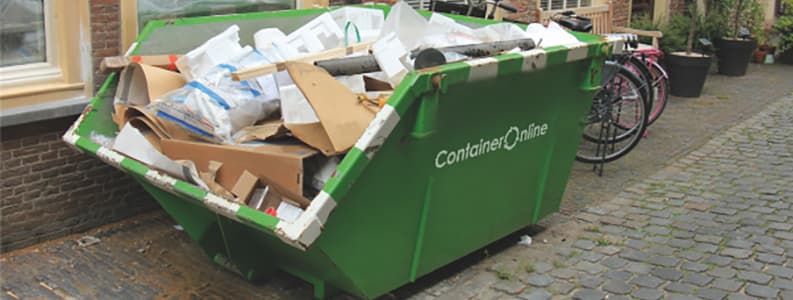
A skip is meant for the waste it was delivered for. If you throw other waste in, it can lead to significant extra costs. If, for example, you've ordered a rubble skip but you also throw wood and plastic in it, the waste processor can no longer process it as rubble and it has to be sorted. It effectively becomes a construction and demolition waste skip. You'll then pay the difference between a rubble skip and a construction and demolition waste skip. This can easily be more than 200 euros. That's simply a waste of money. Even if there's only a small amount of a different waste type in it, the waste processor can't be sure there isn't more at the bottom. The skip will still need to be sorted, which brings extra costs.
Surcharge
Make sure you know exactly what's in the skip, and also what's allowed in it. Some types of waste quickly lead to a surcharge, such as car tyres, mattresses and electrical appliances. So check carefully what can and can't go in the skip. For every waste type you'll find a list on the website of what is and isn't allowed. If you're unsure, just get in touch. A quick call or email could easily save you a surcharge.
What if I didn't put any other waste in it myself?
Sometimes you may have carefully put only the right waste in the skip, yet a different waste type turns up when it's collected. Especially if it's on a public road, someone else could easily throw something in. You're responsible for the contents of the skip, so it's a waste of money if you end up with extra costs because of it. So do what you can to stop others from dumping waste in your skip. For example, by covering it with a tarpaulin, putting up a sign or choosing a closed skip. Especially if you won't be there when the skip is collected.
Tip 4 – Have it collected on time
When you hire a skip, it can stay on site free of rental charges for 6 weeks. If it stays longer than 6 weeks, weekly rental is charged. That's a shame if it isn't necessary, of course. So plan your project carefully and make sure you know how long the container can stay and have it collected on time. If the container has been outside your house for a while, you might forget exactly how long it has been there. After a few weeks, you'll automatically get a reminder email. But it can always happen that you don't receive it for some reason. It might end up in your spam folder, you might have ordered the skip with a different email address, or something might go wrong. So put a note in your diary to make sure the container is collected on time.
If the project takes longer than planned, think carefully about the smarter option: do you have the container taken away and order a new one later, or is it cheaper to keep it for a few more weeks? If the container is already fairly full and you're not sure how much waste you'll produce when you start again, it's often cheaper to have it collected and get a new one delivered later. You usually have more waste than you expect, so you might need to order a second container later anyway. Then those extra weeks of rental would be money wasted.
Tip 5 – if in doubt, order a bigger container
You start your job full of enthusiasm. You've worked out how much rubble or other waste there will be, friends are coming to help, and you all start breaking, sawing and clearing. The container is filling up nicely, but at some point it gets harder and harder to find space in it. There's still a bit of wall to knock down, or there's still plenty of stuff that needs to go. It won't all fit. That means hiring another container. What a waste. So make sure you know how many cubic metres of waste you have and which container you need.
You almost always have more waste than you think beforehand. If you work out that you have almost 3 cubic metres of waste, you probably won't manage with a 3 m3 container. Bricks laid neatly on top of each other take up less space than a pile of loose bricks, and once you're in the middle of the job, all sorts of other things tend to turn up. The container can be filled up to 20 centimetres above the rim, but you can still run out of space quickly. The rule of thumb is: if you have exactly enough for one container size, order the next size up. That's cheaper than ordering a second container. A 6 m3 rubble skip, for example, only costs a few tens of euros more than a 3 m3 one.
If you're just short of space, it can help to load your container more efficiently. There are a few tricks for filling the container cleverly. For example, stand flat boards along the sides of the container, and don't just throw everything in: look at where each item fits best. Also, some things that are waste to you may be valuable to others. Your neighbour might like those nice planks or garden paving stones, you can take old metal to a scrap metal collector, and that little table might be perfectly good to go to the charity shop.
Tip 6 – check whether you need a permit
In many municipalities you need a permit to place a waste skip on council land. Even if it was fine last time, that's no guarantee you won't get a fine this time. So check beforehand whether you need a permit for a container. It's especially important to have a permit if the container is on a parking space or somewhere a lot of people pass by. If you're not sure whether you need a permit, check the municipality's website or contact the municipality to ask. A fine for placing a container without permission can sometimes be quite steep.
Have the container collected in good time
A permit often runs until a certain date. Keep this in mind when planning your job. The waste collector sometimes needs a few days to collect the container, too. So let them know in good time when the container is ready to be collected. You don't want your permit to run until Tuesday and the container to be collected on Wednesday, just fifteen minutes after the traffic warden has done their rounds…
More posts
29 June 2026 · Renovating
How long a waste skip can stay
Got a job that takes one day, or a few weeks or months? Here's how long a waste skip can stay. After this period, you pay a rental charge.
Continue reading
2 April 2021 · Renovating
Waste skip on a Saturday?
Want a waste skip delivered on a Saturday? How does it work, and is it even possible? What should you keep in mind if you're planning a weekend DIY job?
Continue reading
3 November 2020 · Renovating
Removing rubble: how is rubble recycled?
Clean rubble is mostly produced during demolition work. When collected separately, this waste can be recycled very effectively.
Continue reading