- 9,1/104,5 out of 5 stars. See our reviews on Kiyoh (opens in a new window)
- Ordered in no time
- Fast delivery
- Sorted quickly

Waste skip hire for moving house. What waste do you have when moving?
23 september 2020 · Ruud Bats
Piles of moving boxes, lugging furniture around; moving house involves a lot of organising and stress. But don't forget the advantages. It gives you time to properly sort through all your belongings, throw out the junk and do some renovating. After all, that's a lot easier in an empty house!
Waste when moving house
Moving house often creates a lot of waste. When clearing out your home, you come across lots of things you never use any more, haven't seen in years or have been putting off sorting out. Old furniture won't be coming to the new house, the old floor has to come out before handover, or all the old clutter in the loft needs to be thrown away.
In the new house, it carries on. The old kitchen and bathroom come out, the new ones go in, the old wallpaper is stripped from the walls, and old walls are knocked down and new ones put up.
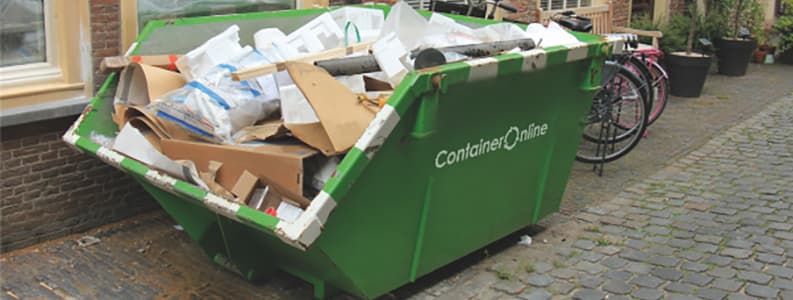
When you're moving house, you can easily hire a waste skip from ContainerOnline. Exactly which one you need depends on your plans!
The best waste skips for a house move
At ContainerOnline we have waste skips for lots of different waste types: garden waste, green waste, wood waste, roofing waste, soil waste and rubble waste. When you're moving house, you're best off choosing a hire a household goods skip.
Bulky waste skip In the bulky waste skip different waste streams can be mixed together. Think of household items such as cupboards, tables, sofas, beds (no mattresses), garden furniture and toys, but some small amounts of construction waste such as wood, metal, rubble, stones and plaster are also allowed. The bulky waste skip is ideal for clearing out your old home during a move. ContainerOnline delivers bulky waste skips throughout the Netherlands. Bulky waste skips are available in the sizes 1m3 (big bag), 3m3, 6m6, 10m3, 20m3 and 40m3.
Construction and demolition waste If you have a lot of demolition to do in your old home, or you're planning a lot of demolition and renovation in your new home, a construction and demolition waste skip is the best choice. Whether you decide to tackle the insulation, remove or put up walls, rip out the old bathroom or kitchen or remove the old floor, a construction skip is suitable because various types of mixed waste are allowed in it. This skip can take rubble, wood, parquet and laminate, aerated concrete, plaster, insulation material, metal, household items, paper and cardboard, and plastics. For example, you can also get rid of a bathtub during a bathroom renovation or kitchen cupboards during a kitchen renovation. All the rubble that comes out during the renovation can go in this skip. Roofing waste, electrical appliances, chemical waste and asbestos-containing appliances are not allowed in the construction waste skip.
Construction waste skips can be ordered in the sizes 1m3 (big bag), 3m3, 6m6, 10m3, 20m3 and 40m3. Try to estimate in advance how much waste you'll have. Then simply order your skip online! Order before 16.00 and it'll be at your door the very next day! B-grade wood is the most common waste type. It includes hardboard, chipboard, fibreboard, pressed wood, furniture, painted, varnished and glued wood, doors, window frames and untreated wood. A lot of waste wood is categorised as B-grade wood.
C-grade wood is impregnated wood that has been treated with certain substances to extend its lifespan. Think of fences (Wolmanised, i.e. pressure-treated) or railway sleepers (tarred), for example. C-wood is the least environmentally friendly type of wood and is processed differently from A-wood and B-wood.
Collection
Wood waste is collected in large-volume waste skips. There are standard all-in rates for a 3m3 skip, 6m3 skip and a 10m3 skip. Lots of different types of wood can go in these skips. In fact, all A-wood and B-wood can be collected in them. This includes plywood, laminated wood and furniture, as long as it has no upholstery. Nails, screws and bolts up to 10mm can simply be left in. What is not allowed in the wood skip is C-wood (chemically treated wood), rotten or burnt wood, material that looks like asbestos, branches, tree trunks, roots and other waste such as glass, bulky waste or garden waste. Do you have a lot of C-wood that needs to be removed? Get in contact with us and we will find a suitable solution.
Recycling
The different categories of wood waste are all about how it is recycled. A-wood can be reused straight away, but when it can no longer be reused in its original form, it can also be shredded and made into new wood products, such as pallets or chipboard.
In many cases, B-wood can be recycled into new wood products just as well as A-wood. First, contaminants such as screws or nails are removed, then the wood is shredded. The chips are pressed together under high pressure to make chipboard. When B-wood is no longer in good condition, it is used as fuel for power stations. Turning B-wood into biogas is less sustainable than recycling it into chipboard, but it does save valuable fossil fuels. On top of that, every tonne of wood used as biomass saves around 75 kg of CO2 emissions.
C-wood cannot be recycled into new wood. Depending on the substances used, it is either destroyed or used as fuel for power stations. While B-wood is mostly burnt in the Netherlands, C-wood is transported to Germany and Sweden, where the facilities meet the environmental requirements for burning treated wood. Never burn impregnated wood yourself! It can release harmful substances that are dangerous to people and the environment.
More posts
29 June 2026 · Renovating
How long a waste skip can stay
Got a job that takes one day, or a few weeks or months? Here's how long a waste skip can stay. After this period, you pay a rental charge.
Continue reading
11 May 2026 · Renovating
6 tips to avoid extra costs
Skip hire comes at a fixed price, but extra costs can still crop up. That's a waste of money and easy to avoid. Read our 6 best tips.
Continue reading
2 April 2021 · Renovating
Waste skip on a Saturday?
Want a waste skip delivered on a Saturday? How does it work, and is it even possible? What should you keep in mind if you're planning a weekend DIY job?
Continue reading