- 9,1/104,5 out of 5 stars. See our reviews on Kiyoh (opens in a new window)
- Ordered in no time
- Fast delivery
- Sorted quickly

Go sustainable: 7 tips for sustainable renovation
21 mei 2019 · Ruud Bats
When we talk about sustainable building, it's usually mainly about new builds. But you can also work sustainably when renovating your home. What's more, extending the lifespan of your home is often even more environmentally friendly than building something completely new. So are you planning to remodel or renovate your home soon? Or just certain parts, such as the kitchen or bathroom? You can make sustainable, energy-efficient choices then too.
Tip 1 – Choose recycled building materials
Perhaps the most enjoyable part of the whole renovation: choosing materials. It's tempting to head to the nearest DIY store and stock up on lovely new building materials, but you could also consider choosing second-hand materials. You can find these on online marketplaces or in charity and second-hand shops, for example, and specialist shops often sell attractive second-hand materials too.
Tip 2 – Choose sustainable materials
Can't find good second-hand materials, or would you really rather have new? Then go for sustainable materials. These also affect the overall CO2 footprint of the renovation.
What are sustainable materials?
Sustainable materials come in various forms and can depend on a number of factors. Take the following points into account as much as possible.
- Choose products with a long lifespan. Quality products don't need replacing often, which reduces the impact on the environment.
- Choose non-toxic materials, or materials for which no toxic substances were used during the production process.
- Choose materials that required little energy during the production process.
- Look at the ecological footprint of the material. How many natural resources were needed to produce it? And how scarce are these resources nowadays?
- Choose natural materials. If a material is harmful to people and you have to wear a face mask to work with it, there's a good chance it's harmful to the environment too.
Which materials are sustainable?
Wood Wood from sustainably managed forests is a sustainable material. These forests are managed in such a way that they remain a healthy habitat for plants and animals. Using wood from sustainable forests gives the forest an economic value, which protects it and stops it from being converted into, for example, a palm oil plantation. A good alternative to non-sustainable hardwood is Accoya wood, which is very well suited to wooden window frames. This wood has been treated with vinegar and has a long lifespan.
Insulation material For insulation, don't choose glass wool or rock wool, but go for natural insulation materials. These are less harmful to the environment, and also to you when you're installing them. Examples include wood fibre insulation and cellulose insulation.
Clay Clay can absorb water vapour and helps regulate humidity. In summer it stores heat, then releases that heat again when the weather turns colder. Clay is also produced using little energy and contains no added chemicals.
Always order new materials made to measure, and take the time to work out the right sizes and quantities.
Tip 3 – Make use of the sun
Deliberately choose more glass, natural stone or ceramic tiles on the side where the sun enters your home. This helps retain the incoming heat. On the other hand, keep the north side closed and add more insulation. Fit roller shutters or blinds so you can easily control how much sunlight comes into your home.
Tip 4 – Reduce your energy consumption
During the renovation, choose options that let you measure your energy consumption, such as installing smart meters. Make sure your home is well insulated too, so you don’t waste lots of energy and see your heating bills go up.
Tip 5 – Think about the future
Look at ways to stay in your home for longer without having to make new investments. How many years will these renovations last you, and what purposes could the renovated rooms serve in the future?
Tip 6 – Use apps and new technology
Make use of handy apps that can help you with your renovation. For example, there are apps for choosing sustainable materials, finding ways to cut your energy use and generating renewable energy.
Tip 7 – Have your construction waste disposed of properly
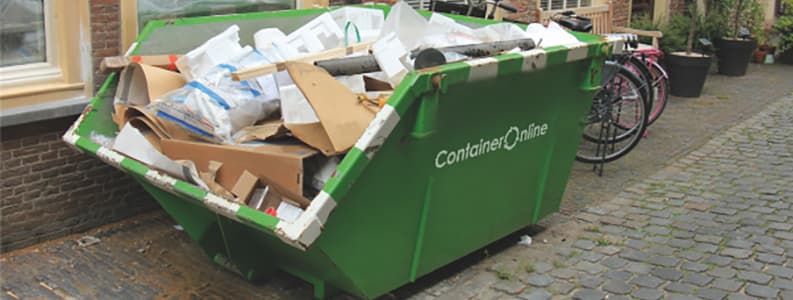
Renovations often produce a lot of construction waste. Have this waste removed properly by a company that processes it in an environmentally friendly way. At ContainerOnline you can order a container for every waste type.
Bonus tip – Just get started!
It can sometimes be tricky to get a clear picture of everything you could take into account with a sustainable renovation, but don’t let that hold you back – just get started! Every little helps, and there’s plenty of information available because the topic is becoming more and more popular. So don’t hesitate to ask your contractor, DIY store or specialist shop for advice.
Do you have any good tips or experiences of your own with sustainable renovation? Let us know in a comment!
More posts
29 June 2026 · Renovating
How long a waste skip can stay
Got a job that takes one day, or a few weeks or months? Here's how long a waste skip can stay. After this period, you pay a rental charge.
Continue reading
11 May 2026 · Renovating
6 tips to avoid extra costs
Skip hire comes at a fixed price, but extra costs can still crop up. That's a waste of money and easy to avoid. Read our 6 best tips.
Continue reading
2 April 2021 · Renovating
Waste skip on a Saturday?
Want a waste skip delivered on a Saturday? How does it work, and is it even possible? What should you keep in mind if you're planning a weekend DIY job?
Continue reading